The Coffin Corner Problem: What the Learjet 60 Tragedy Teaches Us About AI Flight-Envelope Protection
Last weekend’s Learjet 60 crash near West Palm Beach was horrific: nine people dead, an in-flight breakup, and a debris field in a residential area. The flight data tells a chillingly fast story — turbulence and icing at 35,000 feet with an outside air temperature near −47°C, a requested climb to 37,000, then a dive exceeding 30,000 feet per minute, a mayday, and structural failure. The NTSB is investigating, and nothing here is a verdict. But the phrase that keeps surfacing from experienced pilots is “coffin corner,” and it’s worth understanding — because it’s exactly the kind of razor-thin control problem that modern AI and envelope-protection systems are built to address.
(This is a technology post, written with respect for the people lost. It is not an accident finding. It’s also personal: I fly in this airspace often, with KPMP among my home airports — this one hits close.)
What “Coffin Corner” Actually Is
At low altitude, an aircraft has a wide band of usable speeds. Climb high enough and two limits march toward each other:
- Low-speed stall — below it, the wing can’t make enough lift and stalls.
- High-speed (Mach) buffet — above it, airflow over the wing goes supersonic, triggering high-speed buffet or Mach tuck (an uncommanded nose-down pitch).
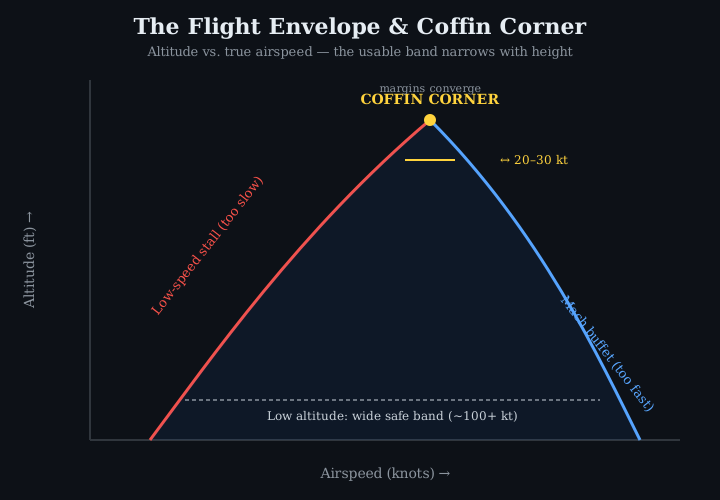
The altitude where these converge is coffin corner. On a jet with a “super-critical” short wing like the Learjet 60, veteran pilots describe the safe window at altitude shrinking to 20–30 knots. Add weight — fuel, bags, passengers — and it shrinks further. Hit turbulence or mountain wave in that state and you can be flung from one stall boundary to the other in seconds. The recovery is fingertip-delicate: push too hard out of a low-speed stall and you trip the high-speed stall; pull too hard and you’re back in the low-speed stall. Muscle it and, as one 15-year Lear 60 pilot put it, “she gets mad and becomes unrecoverable.”
That’s a human being asked to hand-balance a dynamically unstable system under extreme stress. It is precisely the regime where machines can help.
The Physics, Step by Step
1. Lift, and why slow = stall. A wing makes lift roughly as L ∝ ½ρV²·S·C_L — air density (ρ), the square of airspeed (V), wing area (S), and lift coefficient (C_L, which rises with angle of attack). To stay level, lift must equal weight. Fly slower and V² drops, so you must raise the angle of attack to compensate. Past a critical angle (~15°), the airflow separates from the top of the wing and lift collapses — the stall. Because lift depends on V², the stall speed is a hard floor.
2. Altitude thins the air — so you must fly faster. Air density ρ falls with altitude (it’s roughly a third of sea-level at 35,000 ft). Less ρ means less lift at a given true airspeed, so your stall happens at a higher true airspeed the higher you go. That’s why the red “stall” curve bends to the right as you climb.
3. The Mach ceiling comes down to meet it. Even though you’re well below the speed of sound, air accelerates as it curves over the top of the wing — locally it can go supersonic while the jet itself is subsonic. When that happens, a shock wave forms, the airflow behind it separates, and you get Mach buffet, loss of lift, and in the worst case Mach tuck — the shock moves the wing’s center of lift aft and pitches the nose down on its own. The speed where this begins (the “critical Mach number”) is a fixed fraction of the speed of sound, and the speed of sound falls as the air gets colder with altitude. So the blue “too fast” limit bends left as you climb.
4. The two curves meet. Red climbing rightward, blue bending leftward — eventually they intersect. Above that altitude there is no speed that is simultaneously fast enough to avoid the stall and slow enough to avoid Mach buffet. That intersection is coffin corner.
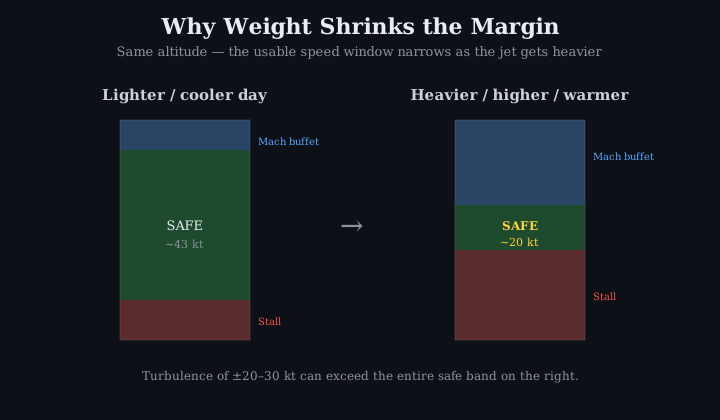
5. Weight makes it worse. More weight means more lift is required, which means a higher stall speed — the red floor rises toward the blue ceiling. A jet that had a comfortable ~43-knot window light can be down to ~20 knots heavy. Now a single turbulent gust of 20–30 knots can exceed the entire usable band at once, slamming the wing into stall and overspeed on alternating swings.
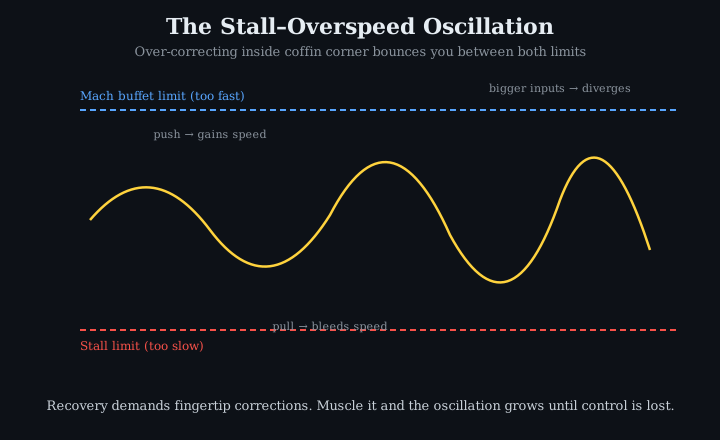
6. Why over-controlling kills. The recovery instinct — push to escape a stall — adds speed toward the Mach limit; pulling to escape overspeed bleeds speed toward the stall. Near the corner the two limits are so close that a normal-sized control input overshoots to the other boundary. Each correction, if too large, lands further out than the last: a divergent oscillation. The only stable strategy is tiny, anticipatory inputs — exactly the kind of continuous, small-correction control loop that automation does better than a startled human.
A related, more visceral cousin of all this is the accelerated stall — a wing can stall at any airspeed and any attitude if you load it up (pull g) past its critical angle of attack. This demo makes the point vividly: Aircraft Accelerated Stall Demo — Any Airspeed, Any Attitude. Near coffin corner, where the margins are already razor-thin, a hard pull that would be harmless at low altitude can trip exactly that.
”Wait — If Air Goes Supersonic Over the Wing, How Do Supersonic Jets Fly At All?”
Fair question, and it gets at the heart of why Mach tuck is a transonic problem, not a supersonic one.
The trouble isn’t supersonic flow itself — it’s the mix of subsonic and supersonic flow at the same time. This middle regime (roughly Mach 0.8–1.2) is called transonic, and it’s the nastiest aerodynamically.
-
In the transonic regime, the aircraft is subsonic overall, but air accelerating over the curved top of the wing goes locally supersonic in patches. Each patch ends in a shock wave sitting partway along the wing. Behind that shock the flow separates, lift drops, and — critically — the shock’s position shifts the wing’s center of lift aft. A lifting force that moves backward pitches the nose down: that’s Mach tuck. It’s an asymmetric, unsteady condition — shocks dancing around on a wing designed for smooth subsonic flow.
-
In true supersonic flight (past Mach 1), the entire flow field is supersonic. There’s one clean, stable shock pattern (a bow shock ahead of the aircraft), no messy mix of regimes, and the center of lift settles into a new, predictable position. Supersonic aircraft are designed for this — thin wings, sharp leading edges, swept or delta planforms, and they either trim out the aft shift of lift or move fuel to rebalance. They power through the transonic zone quickly rather than loitering in it.
So the difference is design intent and where you live on the Mach scale:
- A Learjet 60 (or any airliner) is a subsonic aircraft. Its wing is optimized to stay below the critical Mach number. Push it into the transonic fringe and it misbehaves — buffet, tuck — because it was never meant to operate with shocks on the wing.
- A Concorde, fighter jet, or SR-71 is built to spend time supersonic. It passes through the ugly transonic band deliberately and briefly, then settles into stable, fully-supersonic flow with a wing shaped for it.
In short: going supersonic is fine if the whole airplane is designed and flown to be supersonic. The danger is the halfway house — a subsonic jet with supersonic patches on its wing, which is precisely the high-speed wall of coffin corner.
What the Remote-Sensing Data Actually Shows
Coffin corner explains the aerodynamic fragility, but what was the atmosphere doing? A detailed preliminary assessment shared by a veteran radar instructor and pilot — working from the 88D Level II data in Mike Gibson’s GR2Analyst v3.0 — sharpens the picture considerably. (It is explicitly not a probable-cause finding; the initiating mechanism remains undetermined.)
The temperature environment argues against classic icing. The 1200 UTC Miami (KMFL) sounding put the freezing level near 15,700 ft, the −38°C level near 33,000 ft, and roughly −48°C at the FL350 pressure surface — matching the crew’s reported −47°C. That is cold enough that precipitation at altitude would most likely be ice crystals, snow, or graupel, not substantial supercooled liquid water. Rosenfeld & Woodley (2000, Nature) documented supercooled liquid persisting to about −37.5°C in exceptional deep convection, but the available data don’t establish those unusual conditions at the aircraft’s altitude. So severe conventional airframe icing is not demonstrated by the evidence to date — a meaningful correction to the early “icing at −47°C” framing.
It does show a dynamically violent convective column. KAMX NEXRAD Level II shows a convective tower reaching roughly 40,000–45,000 ft, with elevated specific differential phase (KDP up to 2.55°/km) in the lower core. In the upper-level scans (4.0° and 5.1°), radial velocity showed about 40 knots of difference across 3.1 nm along the 007° radial — a gradient near 0.0036 s⁻¹, consistent with upper-level divergence above organized convection. Doppler spectrum width near the aircraft’s 17:48:19 UTC position measured about 12.6 knots, indicating appreciable velocity dispersion. None of this pins down the actual updraft speed or the turbulence intensity the jet felt — but it paints a dynamically active environment with strong vertical motions right where N722BD was.
A high-altitude performance squeeze may compound it. At FL350 with wing and nacelle bleed-air anti-ice running, engine performance drops — reducing the excess thrust available to hold airspeed or climb in turbulence. The Learjet 60 AFM (FM-123, Change 37, Sections II and V) is the framework for evaluating anti-ice operation, stabilizer-icing considerations, and performance. The aircraft’s electrically heated horizontal stabilizer is worth investigating as a possible source of aerodynamic contamination or disturbance — though a tailplane stall has not been established.
The tentative synthesis: the evidence more strongly supports a convective-weather-related upset — turbulence plus reduced high-altitude performance margins plus an aerodynamic or control disturbance — than severe supercooled-liquid-water icing. The initiating mechanism is still undetermined. This is exactly the kind of multi-source remote-sensing picture that AI nowcasting systems (next section) are built to assemble before a crew climbs into it, not after.
References: Rosenfeld, D., & Woodley, W. L. (2000). Deep convective clouds with sustained supercooled liquid water down to −37.5°C. Nature, 405, 440–442. doi:10.1038/35013030. · Learjet 60 Airplane Flight Manual, FM-123 (FAA-approved, Change 37), Sections II & V. · NOAA/NWS KAMX WSR-88D Level II, 1 Nov 2026 ~1745–1751 UTC (reflectivity, radial velocity, KDP, spectrum width; GR2Analyst). · NOAA/NWS Miami (KMFL) upper-air sounding, 1 Nov 2026 1200 UTC. Radar analysis courtesy of a veteran radar instructor/pilot; shared as a preliminary assessment, not a cause finding.
Where AI and Automation Come In
1. Real-time flight-envelope protection. Fly-by-wire airliners (Airbus A320/A350, modern Boeing) already run continuous envelope protection — the flight computers resist control inputs that would take the jet past stall or overspeed. The frontier now is adaptive protection: machine-learning models that estimate the instantaneous, weight- and altitude-dependent stall margin and the shrinking gap in coffin corner, then intervene or cue the pilot before a boundary is crossed. Many legacy business jets, the Lear 60 included, predate this — they rely on stall warning, a stick-pusher, and pilot skill. Retrofitting ML-driven envelope awareness into that class of aircraft is an active, meaningful problem.
2. Predictive turbulence and icing nowcasting. The crew reported turbulence and icing, but the remote-sensing picture above is more nuanced: at −47°C the precipitation aloft was most likely ice crystals and graupel, and the stronger signal is a violently convective column with upper-level divergence — i.e., a turbulence/updraft environment more than a classic supercooled-icing one. Either way, the operational rule is the same: don’t try to top the thunderstorm. AI weather models now fuse onboard radar, satellite imagery, lightning data, Level II NEXRAD products, and crowd-sourced fleet reports to nowcast convective hazards minutes ahead and route around them. Onboard radar on a small jet is far less capable than an airliner’s; augmenting it with datalinked AI hazard maps directly attacks the decision to climb into deep convection rather than deviate around it.
3. Air-data and angle-of-attack sensor fusion. Many loss-of-control accidents involve unreliable airspeed or AoA data (ice-blocked probes, sensor disagreement). ML-based sensor fusion can cross-check multiple sources, detect a lying sensor, and synthesize a trustworthy estimate — the difference between a computer that helps and a computer (like MCAS) that trusts one bad input.
4. Decision support before the corner. The least glamorous and maybe most valuable layer: systems that flag, before a climb, that a given weight + altitude + temperature + convective-weather combination puts you into a dangerously thin margin — nudging the crew to stay lower or deviate earlier. The reported “request climb to 37,000” into that environment is exactly the decision such a tool is meant to inform.
The Honest Limits
AI is not a magic shield. Envelope protection can be degraded by the very sensor failures it depends on. Nowcasting is probabilistic, not omniscient. And automation introduces its own failure modes — over-reliance, mode confusion, and the hard lesson of MCAS that a protection system fed bad data can cause the accident. The goal isn’t to remove the pilot; it’s to widen the margin for human error and buy seconds in a regime where seconds are everything.
Why This Matters Beyond Aviation
Coffin corner is a near-perfect metaphor for a whole class of AI-safety problems: a system operating in a narrow stable band between two catastrophic failure modes, where naive, aggressive corrections flip you from one to the other. The right answer is the same in the cockpit and in a control loop — continuous estimation of the shrinking margin, small corrections, and intervention before the boundary, not after.
Our thoughts are with the families of the nine lost near West Palm Beach. The engineering lesson that honors them is the one working pilots already teach: respect the corner, don’t try to top the storm — and build machines that help us stay inside the window.